read
UMD Team Crossfire Advances in $11M XPRIZE Challenge
Press Release
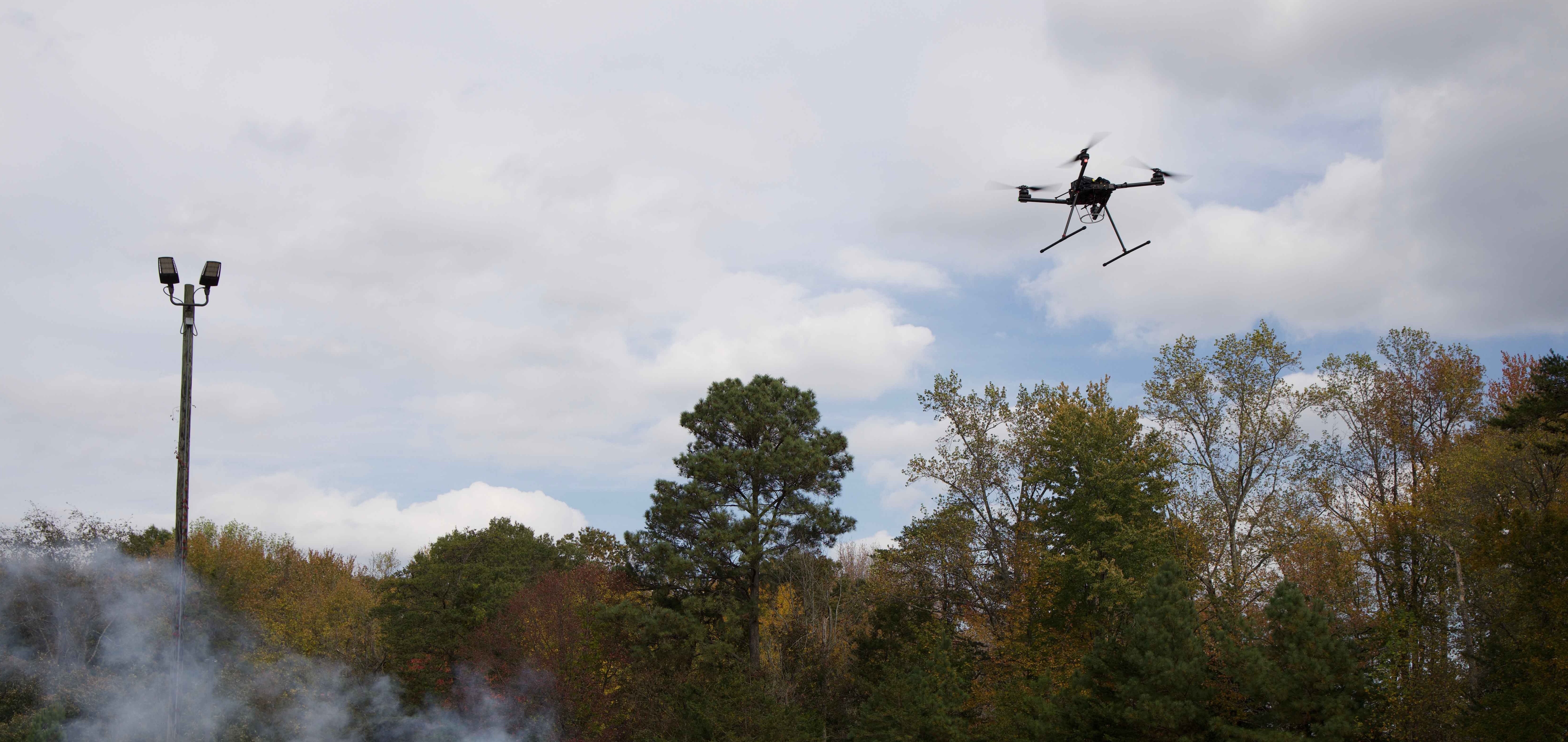
Team Crossfire controls an Unmanned Aerial Vechicle (UAV) to combat wildfires.
xFoundry's powerhouse multidisciplinary team of students, faculty, and staff from the University of Maryland have reached the final stage of semifinals in the XPRIZE Competition to End Destructive Wildfires. This ambitious, four-year challenge focuses on neutralizing the extreme, high-damage fires that account for just 3% of all wildfires but drive over 80% of damages.
Team Crossfire, an xFoundry Xpand initiative, is tackling the devastating challenge presented by climate change-fueled events like severe drought and extreme winds.
Engineering that Changes Lives
Team Crossfire, led by the Department of Fire Protection Engineering and xFoundry@UMD, advanced to the semifinals earlier this summer after demonstrating an impressive three-step system: detection, reconnaissance, and suppression. The team draws expertise from across campus, uniting researchers from the university Departments of Aerospace Engineering, Fire Protection Engineering (FPE), Mechanical Engineering, Maryland Robotics Center, UAS Research and Operations Center (UROC), MATRIX Lab, and the Maryland Fire and Rescue Institute (MFRI), among others. Together, they launched after entering the competition in the spring of 2024.
"[F]rom the very beginning, we knew that the UMD ecosystem had a considerable amount of expertise relevant to this problem," said Fernando Raffan-Montoya, an assistant professor in FPE and a team lead. "We’re proud about the work developed by our students, and the competition has allowed us to expose them to a hands-on, multi-year project that aligns well with our mission: Engineering that changes lives."
Rapid, Autonomous Suppression
Team Crossfire is competing in the $5 million Autonomous Wildfire Response Track, which focuses on the rapid and autonomous detection and suppression of destructive, high-risk fires in environmentally challenging areas.
The team’s impressive system operates through multiple coordinated steps in just a few minutes. An Unmanned Aerial Vehicle (UAV) scans an area for active fires and, if detected, gathers critical location and size data, immediately passing it to a suppression vehicle. The suppression vehicle, another UAV in Crossfire's solution, navigates rapidly to the fire location and efficiently drops a suppressant, extinguishing the fire.
To achieve their goal, Team Crossfire has been leveraging participation from 4 colleges and over 10 individual departments and research centers on UMD and USMSM’s campuses. Tests have been conducted at the MFRI testing facilities located in College Park and La Plata, Maryland.
"We see this as a platform that could be useful anywhere from the Chesapeake watersheds to the high desert and dry forests out West.” said Phillip Alvarez, Ph.D., Associate Director of Ventures and Partnerships at xFoundry. If successful, we may soon turn our efforts into a company and scale across Maryland, and the rest of the country, to help stop destructive wildfires in their tracks for good."
Watch the informational video below:


xFoundry's powerhouse multidisciplinary team of students, faculty, and staff from the University of Maryland have reached the final stage of semifinals in the XPRIZE Competition to End Destructive Wildfires. This ambitious, four-year challenge focuses on neutralizing the extreme, high-damage fires that account for just 3% of all wildfires but drive over 80% of damages.
Team Crossfire, an xFoundry Xpand initiative, is tackling the devastating challenge presented by climate change-fueled events like severe drought and extreme winds.
Engineering that Changes Lives
Team Crossfire, led by the Department of Fire Protection Engineering and xFoundry@UMD, advanced to the semifinals earlier this summer after demonstrating an impressive three-step system: detection, reconnaissance, and suppression. The team draws expertise from across campus, uniting researchers from the university Departments of Aerospace Engineering, Fire Protection Engineering (FPE), Mechanical Engineering, Maryland Robotics Center, UAS Research and Operations Center (UROC), MATRIX Lab, and the Maryland Fire and Rescue Institute (MFRI), among others. Together, they launched after entering the competition in the spring of 2024.
"[F]rom the very beginning, we knew that the UMD ecosystem had a considerable amount of expertise relevant to this problem," said Fernando Raffan-Montoya, an assistant professor in FPE and a team lead. "We’re proud about the work developed by our students, and the competition has allowed us to expose them to a hands-on, multi-year project that aligns well with our mission: Engineering that changes lives."
Rapid, Autonomous Suppression
Team Crossfire is competing in the $5 million Autonomous Wildfire Response Track, which focuses on the rapid and autonomous detection and suppression of destructive, high-risk fires in environmentally challenging areas.
The team’s impressive system operates through multiple coordinated steps in just a few minutes. An Unmanned Aerial Vehicle (UAV) scans an area for active fires and, if detected, gathers critical location and size data, immediately passing it to a suppression vehicle. The suppression vehicle, another UAV in Crossfire's solution, navigates rapidly to the fire location and efficiently drops a suppressant, extinguishing the fire.
To achieve their goal, Team Crossfire has been leveraging participation from 4 colleges and over 10 individual departments and research centers on UMD and USMSM’s campuses. Tests have been conducted at the MFRI testing facilities located in College Park and La Plata, Maryland.
"We see this as a platform that could be useful anywhere from the Chesapeake watersheds to the high desert and dry forests out West.” said Phillip Alvarez, Ph.D., Associate Director of Ventures and Partnerships at xFoundry. If successful, we may soon turn our efforts into a company and scale across Maryland, and the rest of the country, to help stop destructive wildfires in their tracks for good."
Watch the informational video below: