read
Health
Infrastructure
Society
Smart User Interface
Your mission:
Create a challenge that, if solved, would incentivize the development of runtime-generated, context-aware user interfaces that autonomously adapt to astronaut cognitive states, mission phases, and environmental conditions, enabling seamless human-machine interaction for lunar operations, deep space missions, and eventual Mars exploration.
Focus on defining the problem, not solving it. The solution topic you create will be the focus of student innovation efforts in the next 18 months.

The Ultimate Destination:
Advancing Human Presence Beyond Earth
Understanding why this matters helps you see the bigger picture and focus your topic on challenges that align with NASA’s mission.
By 2040, NASA plans to establish a sustained presence on the Moon with up to 144 people living in lunar habitats for 45+ days at a time, preparing for the first human missions to Mars. This vision requires a fundamental shift in how astronauts interact with increasingly complex spacecraft systems, robots, life support infrastructure, and scientific instruments.
The challenge is severe: astronauts on the lunar surface must monitor hundreds of data streams across habitat systems, rovers, experiments, and health devices. Current interfaces, designed months in advance with fixed menu structures, force crew members to search through irrelevant information during critical moments. When a habitat pressure alarm triggers at 3 AM while simultaneously managing a rover malfunction and medical emergency, every second spent clicking through menus could be catastrophic.
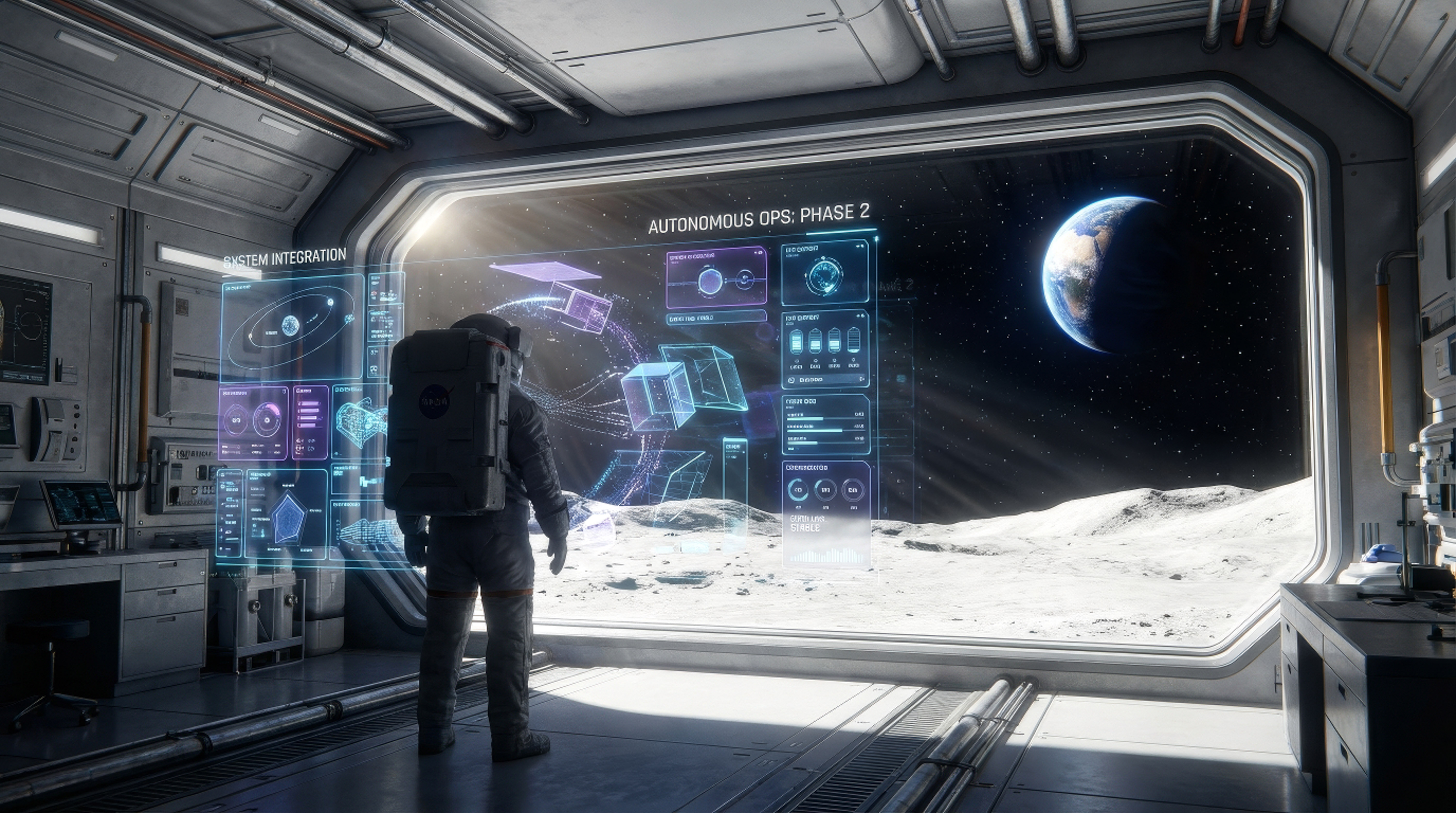
Runtime Generative UI represents a shift from designed interfaces to generated experiences. Instead of predetermined screens, AI systems analyze the astronaut's immediate situation (their mental workload, the mission phase, environmental conditions, and task urgency) and assemble custom interface elements in real-time from a library of validated components. A routine systems check might show a simple dashboard, while an emergency automatically surfaces only the controls needed for that specific scenario.
For missions beyond low-Earth orbit, this becomes mission-critical. Mars missions will experience communication delays of up to 20 minutes each way, making real-time ground support impossible. Astronauts must make complex decisions autonomously, supported by intelligent systems that present information tailored to their immediate needs without overwhelming them. NASA's Bedford Workload Scale mandates specific cognitive load ratings, and interfaces that adapt to workload in real-time are essential to meeting these requirements.
Starting with lunar operations provides an ideal testing ground. The Moon offers 2.5-second communication with Earth, allowing ground teams to validate autonomous interface generation while maintaining safety oversight. Success on the Moon will prove these systems can support the complete autonomy required for Mars, where astronauts will live and work for years with minimal Earth support.
This technology enables the scale-up NASA envisions: permanent lunar settlements with rotating crews, autonomous robotic infrastructure, resource processing facilities, and eventually, the first self-sustaining Martian colonies. Each requires interfaces that serve users with different expertise levels (astronauts, scientists, engineers, medical professionals) while adapting to the unique demands of off-world operations.
The Flight Plan:
Core Requirements for Mission Success
These six core requirements highlight the foundational capabilities needed today to establish a trajectory toward runtime generative interfaces that will support NASA's 2040 lunar presence and Mars missions, while also creating immediate value in terrestrial high-stakes environments.

Validated Component Library Standards
Establish standardized libraries of atomic, safety-verified interface components (buttons, data displays, alert mechanisms, input controls) with formal specifications that enable AI systems to programmatically assemble interfaces while guaranteeing functional correctness and meeting accessibility requirements.
01
Context Representation and Reasoning Systems
Create structured frameworks for representing operational context (task type, environmental conditions, available resources, user expertise, system state) and reasoning about which interface elements are relevant for specific situations, enabling consistent decision-making about what to display.
03
Safety Verification and Validation Methodologies
Develop systematic approaches for verifying that AI-generated interfaces meet safety-critical requirements before deployment, including formal methods for checking component combinations, testing for edge cases, and implementing human-in-the-loop validation for high-risk scenarios.
05
Cognitive State Monitoring Frameworks
Develop reliable methodologies for measuring cognitive load, attention, stress, and fatigue through non-invasive sensors and interaction pattern analysis, creating baseline standards that enable interfaces to detect when users are approaching cognitive capacity limits.
02
Multimodal Interaction Protocols
Establish technical standards for generating interfaces that function across visual, auditory, haptic, and gestural modalities, with clear fallback hierarchies that enable graceful degradation when specific interaction channels are unavailable or compromised.
04
Cross-Platform Generation Architectures
Build technical foundations that enable the same interface generation logic to produce appropriate outputs for diverse hardware (tablets, wall displays, wearables, vehicle consoles) and software environments (web, native applications, embedded systems) while maintaining consistent interaction patterns.
06
Validated Component Library Standards
Establish standardized libraries of atomic, safety-verified interface components (buttons, data displays, alert mechanisms, input controls) with formal specifications that enable AI systems to programmatically assemble interfaces while guaranteeing functional correctness and meeting accessibility requirements.
01
Cognitive State Monitoring Frameworks
Develop reliable methodologies for measuring cognitive load, attention, stress, and fatigue through non-invasive sensors and interaction pattern analysis, creating baseline standards that enable interfaces to detect when users are approaching cognitive capacity limits.
02
Context Representation and Reasoning Systems
Create structured frameworks for representing operational context (task type, environmental conditions, available resources, user expertise, system state) and reasoning about which interface elements are relevant for specific situations, enabling consistent decision-making about what to display.
03
Multimodal Interaction Protocols
Establish technical standards for generating interfaces that function across visual, auditory, haptic, and gestural modalities, with clear fallback hierarchies that enable graceful degradation when specific interaction channels are unavailable or compromised.
04
Safety Verification and Validation Methodologies
Develop systematic approaches for verifying that AI-generated interfaces meet safety-critical requirements before deployment, including formal methods for checking component combinations, testing for edge cases, and implementing human-in-the-loop validation for high-risk scenarios.
05
Cross-Platform Generation Architectures
Build technical foundations that enable the same interface generation logic to produce appropriate outputs for diverse hardware (tablets, wall displays, wearables, vehicle consoles) and software environments (web, native applications, embedded systems) while maintaining consistent interaction patterns.
06
Ground-Level Relevance:
Driving Change for Earth, First
How does your topic create meaningful change? The most compelling solution topics bridge the needs of Earth and the demands of space, offering scalable, impactful answers to humanity's biggest challenges. Before diving into feasibility, consider how your topic can shape the world today while paving the way for tomorrow.
Can it scale?
- Could this topic’s impact extend across different Earth regions or populations?
- Does it address universal needs or challenges that apply broadly?
Does it solve a major problem?
- Does your topic address a significant barrier to space exploration or human survival?
- Can it simultaneously solve pressing challenges on Earth, like resource scarcity or climate change?
Can it adapt?
- Is your topic flexible enough to work in diverse environments on Earth and eventually on Mars?
- Could it be modified or enhanced as technology evolves?
Will it inspire future work?
- Does your topic create a foundation for further innovation?
- Could it lead to spinoff technologies or applications?

The Feasibility Factor:
Turning Ideas Into Action
Is your topic realistic? Even the most transformative ideas need to be grounded in feasibility. This is about asking the practical questions. Great solution topics are ambitious but achievable within a defined scope.
Can measurable progress be made within 18 months?
Does it rely on existing tools and technology, or those likely available by 2027?
Is your topic specific, focused, and actionable?
Is it practical within budget, manpower, and material constraints?
Can it be scaled for use across regions or contexts?
Does it address a real-world problem with the potential for meaningful impact?
Potential markets
Runtime generative UI technology addresses massive markets with immediate revenue potential while developing capabilities essential for NASA's 2040 lunar presence. These innovations promise safer operations for astronauts and transformative solutions for high-stakes Earth environments.
1. Emergency Medical Systems
- Market Size: Global emergency care market projected at $156 billion by 2027, with 139 million emergency visits annually in the US alone.
- NASA Link: Astronauts serving as their own first responders face identical challenges: limited expertise, high cognitive load, communication delays. Interfaces that generate patient-specific treatment guidance translate directly from lunar habitats to rural emergency departments.
- Value Proposition: Generate streamlined interfaces that surface only relevant medical history and treatment options based on symptoms, reducing cognitive load during critical moments and potentially saving thousands of lives annually.
2. Industrial Control Room Operations
- Market Size: Global process control systems market valued at $87 billion in 2024, encompassing oil, gas, chemical plants, power generation, water treatment, and manufacturing facilities.
- NASA Link: Mission control interfaces for lunar base operations mirror industrial control rooms: monitoring life support, power systems, and robotic operations. Context-aware interface generation that helps astronauts manage habitat systems enables control room operators to focus on critical parameters during emergencies.
- Value Proposition: Reduce operator cognitive load by 40%, decrease response time to problems by 60%, prevent incidents through interfaces that surface warning signs before parameters reach alarm states.
3. Aviation and Autonomous Vehicles
- Market Size: Aviation cockpit systems market at $5.2 billion by 2030. Advanced driver assistance systems at $67 billion by 2027, growing 15% annually.
- NASA Link: Spacecraft piloting and lunar rover operation in communication-delayed environments require interfaces that adapt to operator cognitive capacity and mission complexity, facing identical challenges as pilots managing automated aircraft and drivers supervising autonomous vehicles.
- Value Proposition: Reduce pilot and driver cognitive load during high-workload phases, improve awareness during automation transitions, enable safer human-autonomy teaming through adaptive information presentation.
4. Defense and Critical Infrastructure
- Market Size: Global military command systems market at $124 billion by 2028. Critical infrastructure systems at $186 billion by 2030.
- NASA Link: Space operations security and deep space communication protocols inform terrestrial defense systems. Command interfaces that adapt to threat level and operator role translate directly between domains.
- Value Proposition: Enable rapid decision-making by generating mission-specific interfaces that combine multi-source intelligence, reduce information overload during critical operations, and adapt security protocols to threat conditions.
5. Remote Patient Monitoring
- Market Size: Remote patient monitoring market at $102 billion by 2031, growing 20% annually. Telemedicine services at $636 billion by 2028.
- NASA Link: Long-duration space missions require continuous health monitoring with minimal crew medical expertise. Autonomous diagnostic systems that adapt medical guidance to available treatments translate to patients managing chronic conditions at home.
- Value Proposition: Generate patient-specific health dashboards that surface actionable insights, adapt medical guidance to health literacy level, enable patients to participate actively in care through interfaces tailored to their capabilities.
6. Educational Technology
- Market Size: Global education technology market at $404 billion by 2025, growing 16% annually. Adaptive learning systems specifically at $7 billion by 2028.
- NASA Link: Training astronauts for mission-critical procedures requires adaptive instruction that responds to individual learning pace and cognitive load. Space crew training systems inform education platforms that generate learning interfaces tailored to student needs.
- Value Proposition: Improve learning outcomes by 35% through interfaces that adapt to student knowledge and cognitive load, reduce dropout rates by eliminating frustration, enable effective learning across diverse abilities and backgrounds.