read
The Mental Health Xperience just tripled our first cohort
April 8, 2026
Cohort update
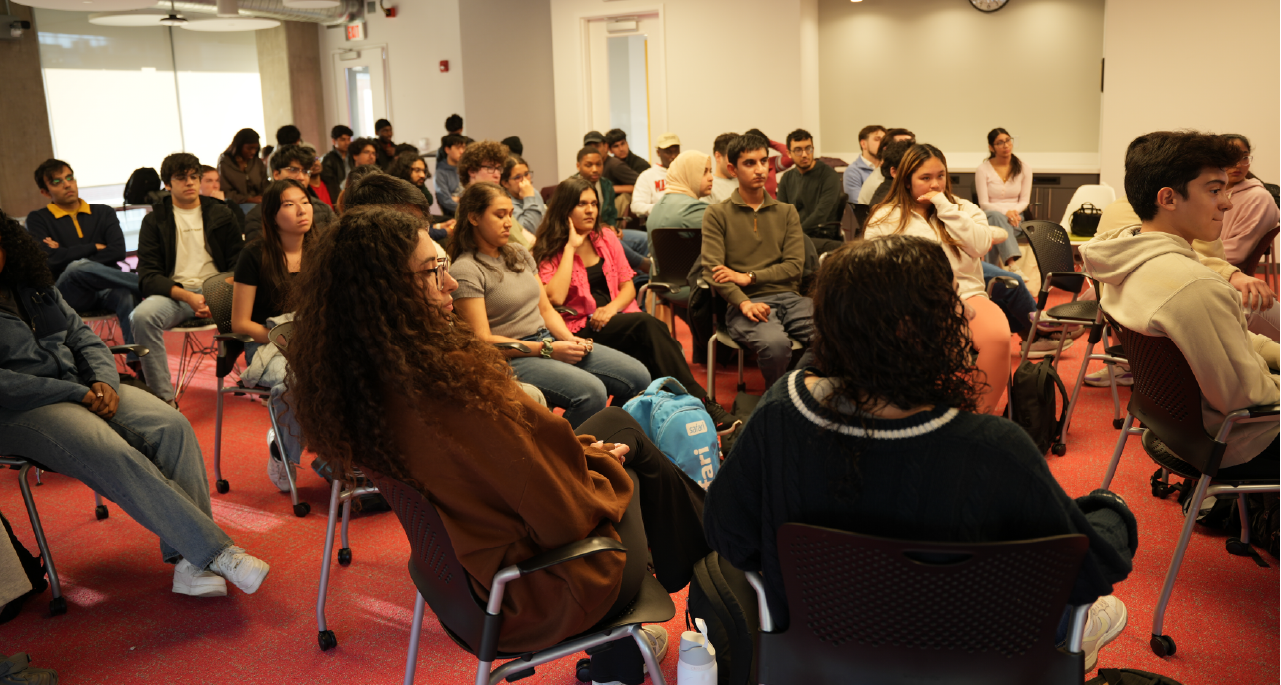
When registration closed on the School Safety Xperience, our first competition ever, we had 89 students on 14 teams. When registration closed on the Mental Health Xperience on March 26, we had 284 students on 62 teams.
That's more than three times the students and more than four times the teams, in a single year.
They come from 58 different degree programs, which works out to roughly one new discipline for every five students who signed up. For a competition built on the idea that the best solutions come from people who don't normally work together, that's the number we care about most. The teams come from the University of Maryland, College Park, the University of Maryland, Baltimore, and SUNY Binghamton. Two of those three weren't here last year.
Over the next twelve months, all 62 teams work on one question: what would actually improve mental health for college students?
It's a harder question than it sounds. The space is crowded with apps, hotlines, and awareness campaigns, most of them designed by people who left college a long time ago and built on assumptions about student life that nobody bothered to test with students. These teams haven't left college. They know which counseling center hours are useless because they conflict with labs, and they know what their roommates actually do at two in the morning instead of calling a hotline.
The part we didn't plan
Teams from two new universities arrived the same way, and it started at last year’s NEXPLORE Summit.
Students from the University of Maryland, Baltimore and SUNY Binghamton came to the summit, went on to compete in our Horizons Challenge, and then decided they wanted to keep going. The Mental Health Xperience is where they landed. We didn't recruit those universities. We ran a summit, opened a challenge, and their students did the rest.
That matters more than it might look. xFoundry was founded at the University of Maryland, launched from it, and is still proudly rooted there. The first cohort centered around school safety was a Maryland story from registration through the final pitch. As we prepare to spin out as an independent nonprofit and open the model to universities across the country, the one question we couldn't answer was whether any of this works somewhere we didn't build it. Now two universities are answering it, and they got here through a pathway we can actually run again.
What 58 degree programs looks like in practice
Dean Chang, Chief Innovation Officer at the University of Maryland, has been watching the teams since they formed.
"As they get to work with each other, they start to pick up skills and tips and tricks from their colleagues in other areas," he said. "That's really cool to see."
That's the force multiplier doing its work, and it's the hardest part of the model to explain to anyone who hasn't watched it happen. Nobody assigns it. It isn't on a syllabus and it doesn't show up on a transcript. It just happens when you put a designer, an engineer, and a public health student in a room with a problem none of them can solve alone.
For a lot of these students, that combination is exactly why they signed up. Aditi Gubba, who is majoring in Public Health at the University of Maryland, put it plainly.
"A lot of my background is built around creating solutions that address societal issues," he said. "Here at xFoundry, it's the perfect environment to really accomplish that."
Up next
Teams are in Prototype Development and User Validation now, and that phase runs until August 16.
Between now and then, every team has to build something a person can actually use, put it in front of real users who have no reason to be polite about it, and then rebuild on what they hear. Most teams will end up abandoning something they were attached to. That's not a failure of the process, it's the process working.
Only the solutions that hold up reach the final round, where teams pitch expert judges and investors. Last cohort, that ended with Team DefenX taking the win and a $250,000 investment to launch a venture around their solution. We're preparing them for that launch now.
Sixty-two teams. Fifty-eight degree programs. One question that has outlasted much better-funded attempts than this.
We'll report from every gate. The next one closes August 16.
When registration closed on the School Safety Xperience, our first competition ever, we had 89 students on 14 teams. When registration closed on the Mental Health Xperience on March 26, we had 284 students on 62 teams.
That's more than three times the students and more than four times the teams, in a single year.
They come from 58 different degree programs, which works out to roughly one new discipline for every five students who signed up. For a competition built on the idea that the best solutions come from people who don't normally work together, that's the number we care about most. The teams come from the University of Maryland, College Park, the University of Maryland, Baltimore, and SUNY Binghamton. Two of those three weren't here last year.
Over the next twelve months, all 62 teams work on one question: what would actually improve mental health for college students?
It's a harder question than it sounds. The space is crowded with apps, hotlines, and awareness campaigns, most of them designed by people who left college a long time ago and built on assumptions about student life that nobody bothered to test with students. These teams haven't left college. They know which counseling center hours are useless because they conflict with labs, and they know what their roommates actually do at two in the morning instead of calling a hotline.
The part we didn't plan
Teams from two new universities arrived the same way, and it started at last year’s NEXPLORE Summit.
Students from the University of Maryland, Baltimore and SUNY Binghamton came to the summit, went on to compete in our Horizons Challenge, and then decided they wanted to keep going. The Mental Health Xperience is where they landed. We didn't recruit those universities. We ran a summit, opened a challenge, and their students did the rest.
That matters more than it might look. xFoundry was founded at the University of Maryland, launched from it, and is still proudly rooted there. The first cohort centered around school safety was a Maryland story from registration through the final pitch. As we prepare to spin out as an independent nonprofit and open the model to universities across the country, the one question we couldn't answer was whether any of this works somewhere we didn't build it. Now two universities are answering it, and they got here through a pathway we can actually run again.
What 58 degree programs looks like in practice
Dean Chang, Chief Innovation Officer at the University of Maryland, has been watching the teams since they formed.
"As they get to work with each other, they start to pick up skills and tips and tricks from their colleagues in other areas," he said. "That's really cool to see."
That's the force multiplier doing its work, and it's the hardest part of the model to explain to anyone who hasn't watched it happen. Nobody assigns it. It isn't on a syllabus and it doesn't show up on a transcript. It just happens when you put a designer, an engineer, and a public health student in a room with a problem none of them can solve alone.
For a lot of these students, that combination is exactly why they signed up. Aditi Gubba, who is majoring in Public Health at the University of Maryland, put it plainly.
"A lot of my background is built around creating solutions that address societal issues," he said. "Here at xFoundry, it's the perfect environment to really accomplish that."
Up next
Teams are in Prototype Development and User Validation now, and that phase runs until August 16.
Between now and then, every team has to build something a person can actually use, put it in front of real users who have no reason to be polite about it, and then rebuild on what they hear. Most teams will end up abandoning something they were attached to. That's not a failure of the process, it's the process working.
Only the solutions that hold up reach the final round, where teams pitch expert judges and investors. Last cohort, that ended with Team DefenX taking the win and a $250,000 investment to launch a venture around their solution. We're preparing them for that launch now.
Sixty-two teams. Fifty-eight degree programs. One question that has outlasted much better-funded attempts than this.
We'll report from every gate. The next one closes August 16.