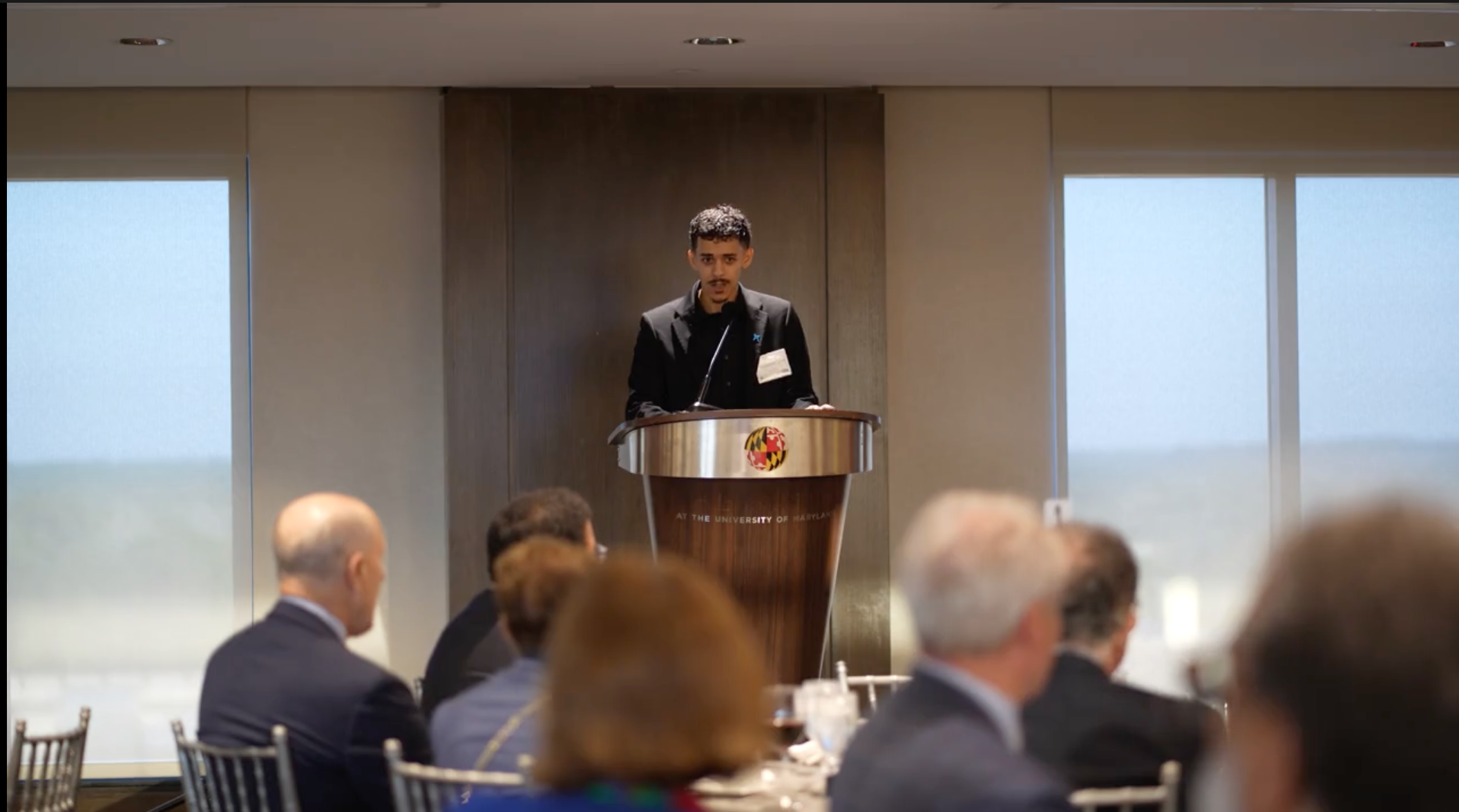
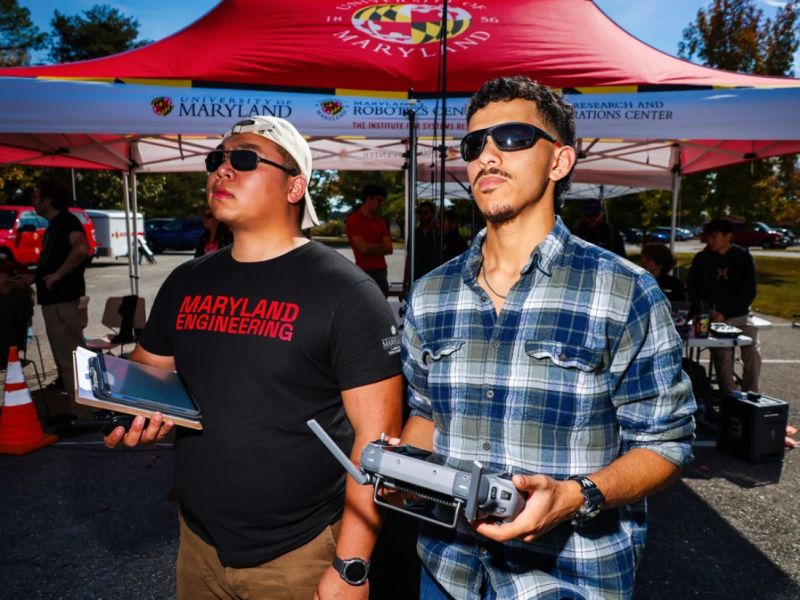
Last year, Yaseen joined Team Crossfire, a multidisciplinary University of Maryland team competing in the $11M XPRIZE Wildfire challenge, building autonomous drones to detect and suppress wildfires. Their competitors included major defense technology firms, while Crossfire operated with a fraction of the budget.
Yaseen wasn’t new to building something from nothing. Before Crossfire, he co-founded an environmental intelligence startup, developing an AI model that automated tree-count detection from satellite imagery. Earlier, he interned at Boeing, where he ran aerospace trade studies under the mentorship of former NASA Chief Scientist Jim Green.
He didn’t come to Crossfire to learn how to build. He came ready.
Last October, the team conducted a live-fire test at MFRI La Plata, where the system operated end to end, autonomously detecting and suppressing fire in real time.
[Insert Quote]“What almost didn’t work during your first live-fire test, and what did you have to figure out in that moment to keep things moving?”
Yaseen led the test as Pilot in Command. He ran pre-mission briefings, coordinated a six-person crew, and oversaw roughly 30 validation flights across more than a dozen burn scenarios. When issues surfaced mid-demonstration, the SOP-driven workflows he had developed, four iterations deep, allowed the team to troubleshoot and recover in under three minutes.
The progress was the result of a deeply collaborative team effort across engineering, operations, and field testing.
The work drew national attention, including coverage from IEEE Spectrum, and the team demonstrated the system to XPRIZE judges that same month.
They didn’t advance to the finals. But by then, the goal had already shifted.
Competitions end. Teams disband. Students move on.
Crossfire is doing something different.
Instead, the work is moving forward beyond the university as a company.
For most student teams, the question stays hypothetical. For Crossfire, it became immediate.
The live-fire test proved the technology could work, and the XPRIZE process pressure-tested it against a global field. Over time, the question shifted from “Can we win this competition?” to “Is this a company?”
For Yaseen, that question became his job.

He led customer discovery with nearly 40 stakeholders across fire agencies, utilities, and insurance organizations, building a real business model grounded in user needs. He translated those conversations into product requirements and priorities, and helped define a path toward commercialization.
The answer, it turns out, was yes.
While many team members are moving on to their next chapters, Yaseen is continuing, taking the technology from a field-tested prototype to a market-ready product.
"Yaseen works harder than anyone in the room, communicates like a founder, and thinks like one too."
- Phillip Alvarez, Team Software Lead, Crossfire
That transition from student contributor to company builder is exactly what xFoundry’s Xpand initiative is designed to make possible.
[Insert Quote]“Most students graduate and look for jobs. You’re choosing to build a company instead. When did that shift happen for you, and what made you commit to it?”
A student who came to UMD to study Aerospace Engineering is now navigating the path from prototype to product as his full-time focus after graduation. He has led field tests, built operational systems, and run customer discovery, all before receiving his diploma.
That is not a typical senior year, and it is not a typical post-graduation plan.
At xFoundry, it is becoming more common.
Yaseen Taha graduates this spring from the University of Maryland, College Park with a B.S. in Aerospace Engineering.
While most of his peers are entering the job market, Yaseen is choosing to build one.
Last year, Yaseen joined Team Crossfire, a multidisciplinary University of Maryland team competing in the $11M XPRIZE Wildfire challenge, building autonomous drones to detect and suppress wildfires. Their competitors included major defense technology firms, while Crossfire operated with a fraction of the budget.
Yaseen wasn’t new to building something from nothing. Before Crossfire, he co-founded an environmental intelligence startup, developing an AI model that automated tree-count detection from satellite imagery. Earlier, he interned at Boeing, where he ran aerospace trade studies under the mentorship of former NASA Chief Scientist Jim Green.
He didn’t come to Crossfire to learn how to build. He came ready.
Last October, the team conducted a live-fire test at MFRI La Plata, where the system operated end to end, autonomously detecting and suppressing fire in real time.
[Insert Quote]“What almost didn’t work during your first live-fire test, and what did you have to figure out in that moment to keep things moving?”
Yaseen led the test as Pilot in Command. He ran pre-mission briefings, coordinated a six-person crew, and oversaw roughly 30 validation flights across more than a dozen burn scenarios. When issues surfaced mid-demonstration, the SOP-driven workflows he had developed, four iterations deep, allowed the team to troubleshoot and recover in under three minutes.
The progress was the result of a deeply collaborative team effort across engineering, operations, and field testing.
The work drew national attention, including coverage from IEEE Spectrum, and the team demonstrated the system to XPRIZE judges that same month.
They didn’t advance to the finals. But by then, the goal had already shifted.
Competitions end. Teams disband. Students move on.
Crossfire is doing something different.
Instead, the work is moving forward beyond the university as a company.
For most student teams, the question stays hypothetical. For Crossfire, it became immediate.
The live-fire test proved the technology could work, and the XPRIZE process pressure-tested it against a global field. Over time, the question shifted from “Can we win this competition?” to “Is this a company?”
For Yaseen, that question became his job.

He led customer discovery with nearly 40 stakeholders across fire agencies, utilities, and insurance organizations, building a real business model grounded in user needs. He translated those conversations into product requirements and priorities, and helped define a path toward commercialization.
The answer, it turns out, was yes.
While many team members are moving on to their next chapters, Yaseen is continuing, taking the technology from a field-tested prototype to a market-ready product.
"Yaseen works harder than anyone in the room, communicates like a founder, and thinks like one too."
- Phillip Alvarez, Team Software Lead, Crossfire
That transition from student contributor to company builder is exactly what xFoundry’s Xpand initiative is designed to make possible.
[Insert Quote]“Most students graduate and look for jobs. You’re choosing to build a company instead. When did that shift happen for you, and what made you commit to it?”
A student who came to UMD to study Aerospace Engineering is now navigating the path from prototype to product as his full-time focus after graduation. He has led field tests, built operational systems, and run customer discovery, all before receiving his diploma.
That is not a typical senior year, and it is not a typical post-graduation plan.
At xFoundry, it is becoming more common.
Yaseen Taha graduates this spring from the University of Maryland, College Park with a B.S. in Aerospace Engineering.
While most of his peers are entering the job market, Yaseen is choosing to build one.