AN xFOUNDRY XPERIENCE COMPETITION

Before You Share

Build a digital product that helps users recover source material and missing context behind digital content, so they can better understand it and reach their own conclusions.

Registration closes February 28, 2027.

Registration October 1, 2026 to February 28, 2027.
Register, find teammates and form your team on ConneXions

18
months
3 to 6
People per team
3+
Academic disciplines
up to
$1M
Proposed SAFE*
The problem

A fragment travels. The context gets left behind.

A thirty-second clip from a two-hour hearing. A headline shared without the article. A statistic that sounds convincing, but has no source attached. The full story is usually out there. The problem is finding it. Sometimes that means opening a dozen tabs, chasing links, and spending twenty minutes just to track down where something came from. By then, the moment has passed.

So most people move on. Not because they do not care about the context, but because finding it takes too much effort. What if getting back to the source was as easy as finding the fragment in the first place? Give people a simple way to see where a clip, claim, or statistic came from, and let them decide what it means.


A row of people standing outdoors, each focused on their smartphones, with the foreground person tapping on the screen.
By the numbers
41%

of U.S. teens say they were misled by content that was real but presented misleadingly.

ITU, Measuring Digital Development: Facts and Figures 2024 → Link

77%

of the news influencers sampled have no newsroom or journalism background

Pew Research Center / Pew-Knight Initiative, America's News Influencers, November 2024 → Link

40%

of people now say they avoid the news, a record high and up from 29% in 2017

Reuters Institute, Digital News Report 2025, June 2025 → Link

WHAT YOU WILL BUILD

More context. Room for your own judgment.

Build a private, user-controlled digital product for college-age users. Help them recover original material, inspect the evidence and understand what a fragment leaves out.

Recover the source

Find the original source, full quote or clip, date, speaker, and the material around it.

Understand the source

See who is speaking, where the material came from, and any relevant credentials or sponsorship, presented as information rather than as a verdict.

Compare sources

See what other relevant sources report, where they agree or differ, and what none of them cover.

Understand the language

Get clear explanations of loaded or technical terms, with the sources behind them, and where definitions differ.

Know where to look next

Point users to the original document, full recording, or reporting that gets them closer to the source.

Leave the judgment to the user

Give people evidence they can inspect and room to decide. No rating, no verdict, no score in place of their judgment.

There isn't one right answer. The approach is up to each team. Start with a focused use case, accessible sources, and a clear reason people would come back. Here are a few directions to explore:

Browser extension

Let users pull up the source and missing context while they read on a supported site.

Share-sheet or mobile companion

Give users a fast, private way to bring a post or link into your product from the app they are already in.

AI-assisted tool

Use models to retrieve, match or explain source material, and measure their errors, limits and cost.

Human-assisted service

Build a digital product backed by human research or review. Account for the time, cost, privacy and operating demands of that work in your economics.

Video or clip tool

Connect a clip to the fuller recording, transcript or original, and explain uncertain matches.

Glass wall in a modern building covered with colorful sticky notes and technical architectural drawings, overlooking people walking in a garden courtyard outside.Two young adults assembling metal frames on a wooden table in a workshop, smiling and working collaboratively with tools nearby.A group of seven people standing on a stage; one person is raising a trophy in celebration.
WHAT YOU MUST PROVE

Useful to people. Credible as a business.

A strong idea isn't enough. You’ll need to show that your product works for real people, handles context responsibly, and has a path beyond the competition.

People choose to return

Show that people use it voluntarily, come back months later, and prefer it to whatever they would otherwise do.

The context stands up

Correct matches, honest limitations, comparable claims, and disclosed gaps.

The business makes sense

Demonstrate real paid demand and a full accounting of what it costs to run: people, models, retrieval, source access, support.

The product operates responsibly

Design for privacy and safety, and show the product performs under real conditions, including what happens when a source is missing or an output is wrong.

WHO YOU BUILD WITH

Different disciplines. One team.

The best ideas rarely come from one perspective. Build a team of 3–6 students from at least three academic disciplines, bringing different skills, questions, and ways of seeing the problem.

Technology

Build it, test it, and figure out what’s possible.

Entrepreneurship

Spot the opportunity, shape the business, and turn ideas into action.

Arts & Athletics

Bring creativity, communication, performance, design, or a different way of seeing the problem.

Marketing

Understand people, tell the story, and make something they want to use.

Science

Ask good questions, test assumptions, and follow the evidence.

Why it's worth 18 months

Real-world experience and an investment-ready product.

This is not a simulation of startup work. Your team will build a digital product, put it in front of real users, test demand over a measured evaluation window and defend its decisions to a judging panel with an investor in the room.

A product beyond the pitch

Go from an idea to a working product in production. Test it with users under the program's research and deployment requirements, then improve it with evidence.

Work you can stand behind

Leave with a record of what you did: research, design decisions, technical work, user learning and commercial evidence.

A team with different strengths

Work across disciplines the way real companies do. Journalism, computer science, design, business, policy, psychology and information science all have obvious roles here.

A proposed $1M investment

Xponential Venture Fund proposes a $1,000,000 SAFE investment in one qualifying winning team's company. This is not a cash prize and not a signed funding commitment.

The road ahead
Mar 2027

Discovery Gate

Show that you understand the problem and the people experiencing it.

Jun 2027

Thesis Lock

Commit to the product thesis you're going to test.

Oct 2027

Deployment Gate

Ship something people can actually use.

Nov 2027–Mar 2028

Live Evaluation

Put it in the world. Watch what happens. Learn from real usage.

Apr 2028

Finals at NEXPLORE

Show what you built, what the evidence says, and what should happen next.

Late entrants share these dates. All missed gates submited together with next gate.

WHO CAN PARTICIPATE
+Age: at least 18 when you register.
+University status: enrolled at sophomore standing or above, including graduate study, or graduated from a US or Canadian university within the preceding 24 months at registration.
+Team: 3 to 6 people representing at least 3 distinct academic disciplines.

Don't have a team? Register anyway. ConneXions is where teams form.

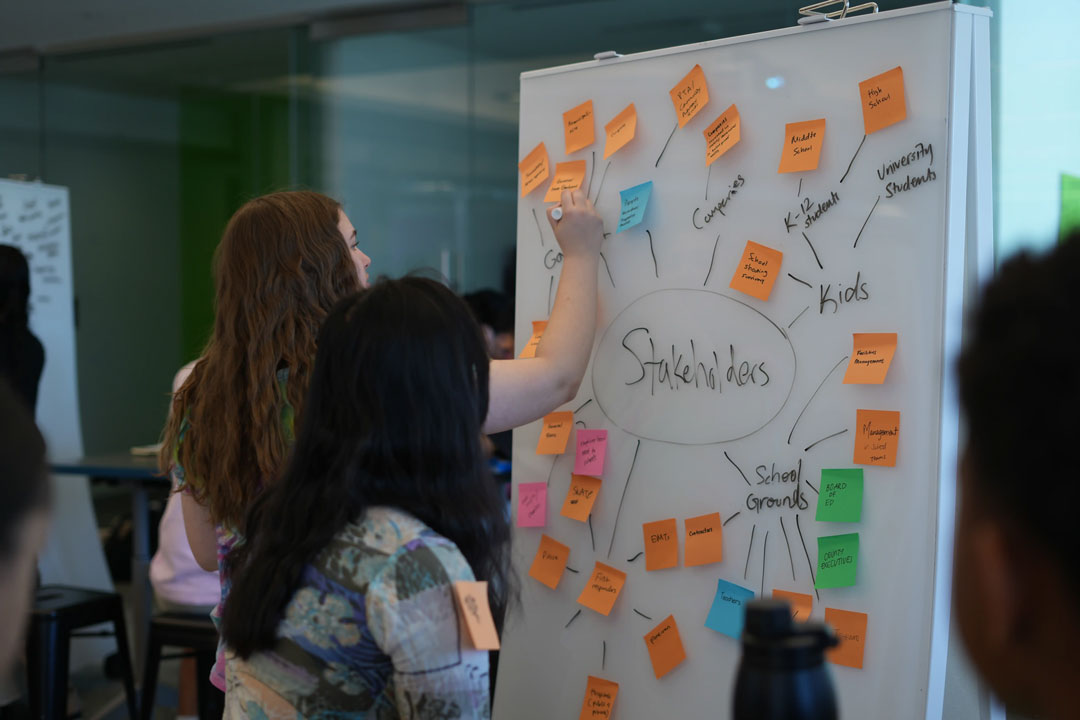
Two women writing and discussing ideas on a whiteboard filled with colorful sticky notes organized around the central word 'Stakeholders', which is connected to categories like Kids, School Grounds, and Companies.

Ready to build something real?

Frequently Asked Questions
What happens when I register?

You get access to ConneXions, where you can find teammates across disciplines and read the competition overview. You are not signing anything. The Official Rules, the Mission Plan and the participation agreements are published by November 30, 2026, and the serious build starts then.

Do we have to use AI?

No. The product must be digital, but it can use human assistance, AI assistance or both. Every approach meets the same product, evidence, privacy and safety requirements, and your development and operating costs count in the business case.

What support will we get?

The Mission Plan, program guidance, mentor matching and access to technical, research and venture resources. Some members of the Horizons Council, the journalists and educators who advised on the design, may choose to mentor. No specific mentor, customer, partner or investment is promised.

Can we work on politics or the 2028 election?

Yes. The topic is your choice and no permission is required. xFoundry recommends caution with polarizing or fast-moving topics: sources move fast and cost more to keep current, mistakes cost more, and demand can vanish after the event. A short-lived market can still be a good business if you know it is short-lived. Answer those questions in your business plan.

What rules apply no matter the topic?

Your product leaves conclusions to the user. It does not decide contested claims, rank creators or outlets, assign political lean or quietly filter sources to remove bias. It shows relevant perspectives and the evidence behind them without treating every disagreement as an even split.

Individualized medical, legal or investment advice is prohibited. Explaining a source is different from telling a person what to do, and a disclaimer does not change that.

Products are private and user-controlled: no ad-supported model, no sale of usage data, no training-data resale, no biometrics, no device fingerprinting, and no individual usage reports to universities or employers. First-cycle users and research participants are adults.

What does it take to win?

Complete the four gates and the non-curable milestones, break no hard rule, and meet the Schedule A standard: 20 percent of your activated users still using the product four months later, measured on a cohort of at least 100 activated users, plus paid demand of either at least $1,000 in cumulative recognized revenue from at least 50 distinct paying users, with at least half of those payers retained at four months under the published payer rule, or at least one paid institutional or adult-family pilot of at least $5,000, with a named buyer and written scope. A letter of intent supports your case but cannot qualify you. Among qualifying teams, the judging panel scores the seven criteria above. If no team meets the standard, no winner is named.

Who owns what we build?

You do. xFoundry claims no ownership of team-built IP. Your university, employer or prior agreements may have a say, so check early. Before any investment closes, your company must hold the rights to the product.

Does Before You Share only apply to social sharing?

No. Sharing is one moment when context matters. Your product can help people understand something privately or make any other decision, without asking them to post anything.

What is the Horizons Council?

An advisory Horizons Council of journalists and educators reviewed the design; xFoundry makes all program decisions.